Introduction
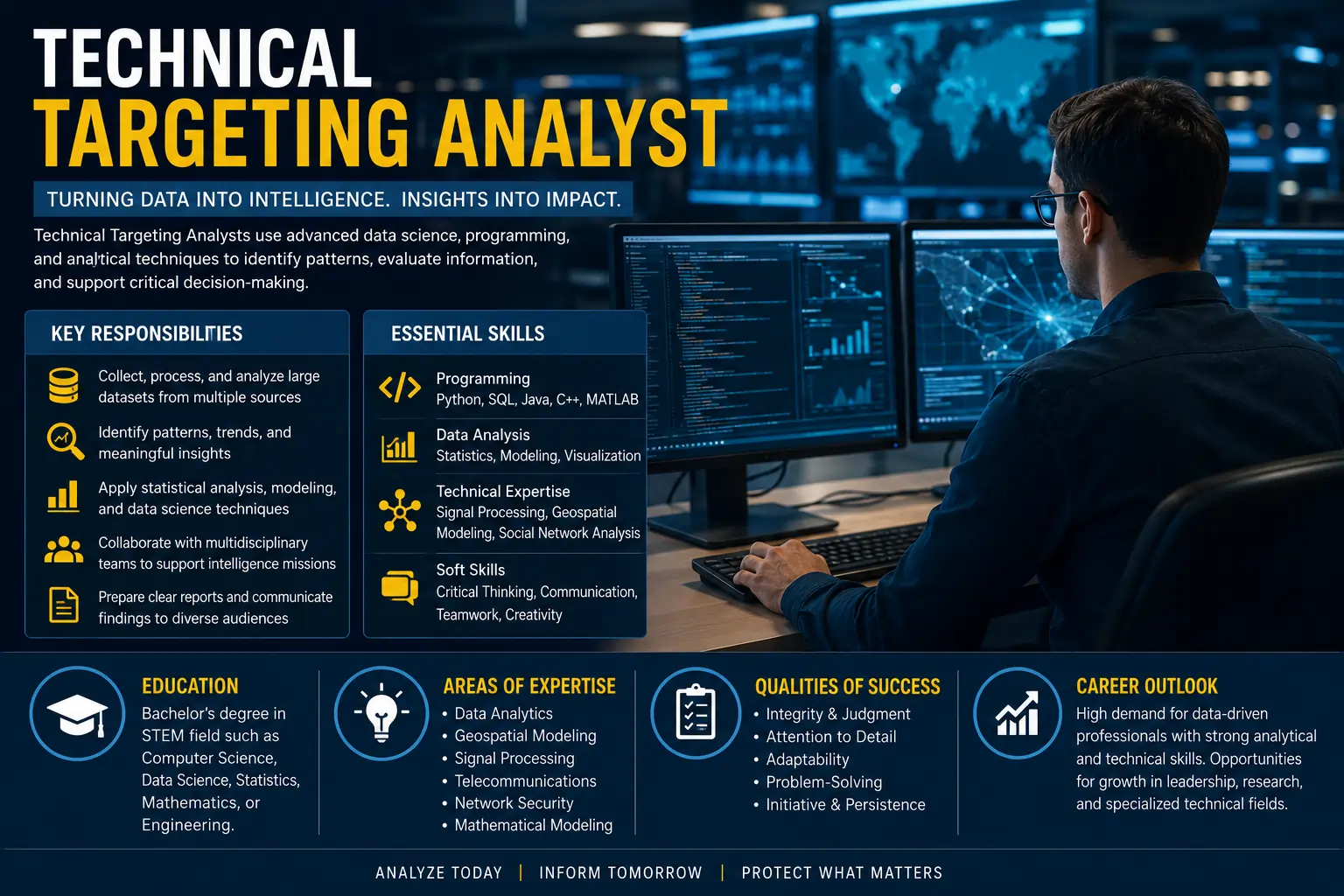
The field of intelligence analysis has evolved significantly with the growth of technology, data science, and advanced analytics. Organizations that handle large amounts of information increasingly rely on highly skilled professionals capable of transforming raw data into meaningful insights. One such career path is that of a Technical Targeting Analyst.
Technical Targeting Analysts play a vital role in identifying patterns, analyzing large datasets, and supporting intelligence operations through advanced analytical methods. These professionals combine expertise in data science, programming, research, and problem-solving to uncover valuable information that assists decision-makers in addressing complex challenges.
This guide explores the responsibilities, qualifications, required skills, educational background, and career prospects associated with the Technical Targeting Analyst profession.
What Is a Technical Targeting Analyst?
A Technical Targeting Analyst is a data-focused intelligence professional who specializes in collecting, processing, and analyzing large volumes of structured and unstructured information. Their primary objective is to identify relationships, patterns, and trends that can help organizations make informed decisions.
The role requires a strong understanding of data analytics, programming, statistical analysis, and emerging technologies. Analysts often work with various information sources and use advanced analytical techniques to support research, investigations, and strategic initiatives.
As technology continues to generate vast amounts of data, the demand for professionals capable of interpreting and utilizing that information effectively continues to grow.
Key Responsibilities of a Technical Targeting Analyst
Technical Targeting Analysts perform a variety of tasks that require both technical expertise and analytical thinking. Common responsibilities include:
Data Collection and Processing
Analysts gather information from multiple sources and prepare datasets for analysis. This often involves:
- Collecting structured and unstructured data
- Cleaning and organizing datasets
- Validating data quality and accuracy
- Integrating information from different systems
Pattern Recognition
A significant part of the role involves identifying meaningful patterns and relationships within large datasets. Analysts use statistical techniques and data science tools to discover trends that may otherwise remain hidden.
Advanced Data Analysis
Technical Targeting Analysts utilize sophisticated analytical methods to:
- Examine large-scale datasets
- Conduct predictive analysis
- Perform statistical modeling
- Generate actionable insights
Technical Research
Analysts continuously research emerging technologies, methodologies, and analytical tools that can improve operational efficiency and effectiveness.
Collaboration
Professionals in this role often work with multidisciplinary teams that may include:
- Data scientists
- Software engineers
- Intelligence professionals
- Researchers
- Technical specialists
Strong collaboration skills help ensure successful project outcomes.
Reporting and Communication
One of the most important responsibilities is translating complex technical findings into clear and understandable reports for diverse audiences.
Analysts must communicate:
- Research findings
- Data-driven recommendations
- Technical assessments
- Strategic insights
Essential Skills for Technical Targeting Analysts
Success in this field requires a combination of technical and interpersonal abilities.
Programming Skills
Knowledge of programming languages is highly valuable. Commonly used technologies include:
- Python
- SQL
- Java
- C++
- C
- MATLAB
Programming enables analysts to automate processes, manage data, and develop analytical tools.
Data Analytics
Strong data analytics capabilities allow professionals to transform raw information into meaningful conclusions. Key areas include:
- Data visualization
- Statistical analysis
- Predictive analytics
- Machine learning fundamentals
Problem-Solving Ability
Technical Targeting Analysts frequently encounter complex challenges that require innovative solutions. Critical thinking and analytical reasoning are essential for addressing these situations effectively.
Research Skills
The ability to conduct detailed research and evaluate information from multiple sources helps analysts produce accurate and reliable assessments.
Communication Skills
Even the most advanced analysis has limited value if it cannot be effectively communicated. Analysts must be able to present technical findings clearly to both technical and non-technical audiences.
Organizational Skills
Managing multiple projects, deadlines, and data sources requires excellent planning and organizational abilities.
Technical Areas of Expertise
Many Technical Targeting Analysts develop expertise in one or more specialized disciplines.
Data Analytics
Data analytics remains one of the most important areas within the profession. Analysts use data-driven techniques to identify trends and support decision-making.
Geospatial Modeling
Geospatial analysis combines geographic information with analytical methods to better understand spatial relationships and patterns.
Signal Processing
Signal processing involves examining electronic signals and communication data to extract meaningful information.
Social Network Analysis
Social network analysis focuses on understanding relationships between individuals, organizations, and entities within complex networks.
Telecommunications
Professionals with telecommunications expertise analyze communication systems, networks, and related technologies.
Mathematical Modeling
Mathematical models help analysts simulate scenarios, evaluate outcomes, and support strategic planning.
Network Security
Knowledge of network architecture and cybersecurity principles enhances an analyst’s ability to understand technical environments and data systems.
Educational Requirements
Most Technical Targeting Analyst positions require a bachelor’s degree or equivalent experience in a relevant STEM field.
Common degree programs include:
- Computer Science
- Data Science
- Information Technology
- Mathematics
- Statistics
- Physics
- Engineering
- Cybersecurity
- Geographic Information Systems (GIS)
A strong academic background demonstrates analytical capability and technical competence.
Students interested in pursuing this career should focus on coursework related to:
- Programming
- Statistics
- Data Analytics
- Machine Learning
- Database Systems
- Research Methods
Importance of Data Science in Modern Intelligence Analysis
Data science has become one of the most influential disciplines in intelligence and analytical professions.
Modern organizations generate massive amounts of information every day. Without advanced analytical techniques, extracting useful insights from this data would be nearly impossible.
Technical Targeting Analysts apply data science principles to:
- Identify hidden trends
- Improve decision-making
- Enhance operational efficiency
- Support strategic objectives
- Reduce information overload
The growing reliance on data-driven decision-making continues to increase demand for professionals with these capabilities.
Career Development Opportunities
Technical Targeting Analysts can pursue various career advancement paths based on their interests and expertise.
Potential progression opportunities include:
Senior Analyst Roles
Experienced professionals often move into senior analytical positions where they oversee complex projects and mentor junior analysts.
Data Science Careers
Many analysts transition into specialized data science roles focused on machine learning, predictive modeling, and artificial intelligence.
Technical Leadership
Individuals with strong technical and management skills may advance into leadership positions overseeing analytical teams.
Research and Development
Some professionals contribute to developing new analytical methods, technologies, and research initiatives.
Specialized Technical Fields
Analysts may choose to specialize further in areas such as:
- Cybersecurity
- Network Analysis
- Geospatial Intelligence
- Statistical Research
- Advanced Analytics
Qualities of Successful Technical Targeting Analysts
Several characteristics distinguish high-performing professionals in this field.
Curiosity
Successful analysts possess a natural desire to explore data, ask questions, and uncover meaningful insights.
Adaptability
Technology evolves rapidly, making adaptability a critical skill for long-term success.
Attention to Detail
Accurate analysis requires careful examination of data and thorough validation of findings.
Integrity
Ethical decision-making and professional responsibility are fundamental aspects of analytical work.
Creativity
Innovative thinking often leads to unique solutions and valuable discoveries.
Persistence
Complex analytical challenges may require significant effort and determination to resolve effectively.
Future Outlook
The future of Technical Targeting Analysis appears promising as organizations continue to invest in data-driven capabilities.
Several trends are expected to influence the profession:
- Growth of artificial intelligence
- Expansion of big data technologies
- Increased automation
- Enhanced predictive analytics
- Greater demand for data science expertise
Professionals who continuously update their technical skills and analytical knowledge will remain highly competitive in the evolving job market.
Conclusion
Technical Targeting Analysts occupy a unique position at the intersection of technology, data science, and analytical research. Their ability to process large volumes of information, identify patterns, and generate actionable insights makes them valuable contributors in modern analytical environments.
A successful career in this field requires strong programming knowledge, data analytics expertise, problem-solving ability, and effective communication skills. With increasing reliance on data-driven decision-making across industries, opportunities for skilled Technical Targeting Analysts are expected to continue expanding in the years ahead.
For students and professionals interested in data analysis, research, and technology, Technical Targeting Analysis represents a challenging and rewarding career path with significant long-term potential.